
At a glance
ISO 9001 vs ISO 14001 compared: quality vs environmental management. Learn the differences, overlaps, and how to run an integrated management system.
- Focus: ISO 9001 · ISO 14001
- Read time: 14 minutes
- Updated: August 10, 2026
ISO 9001 vs ISO 14001: Understanding the Difference
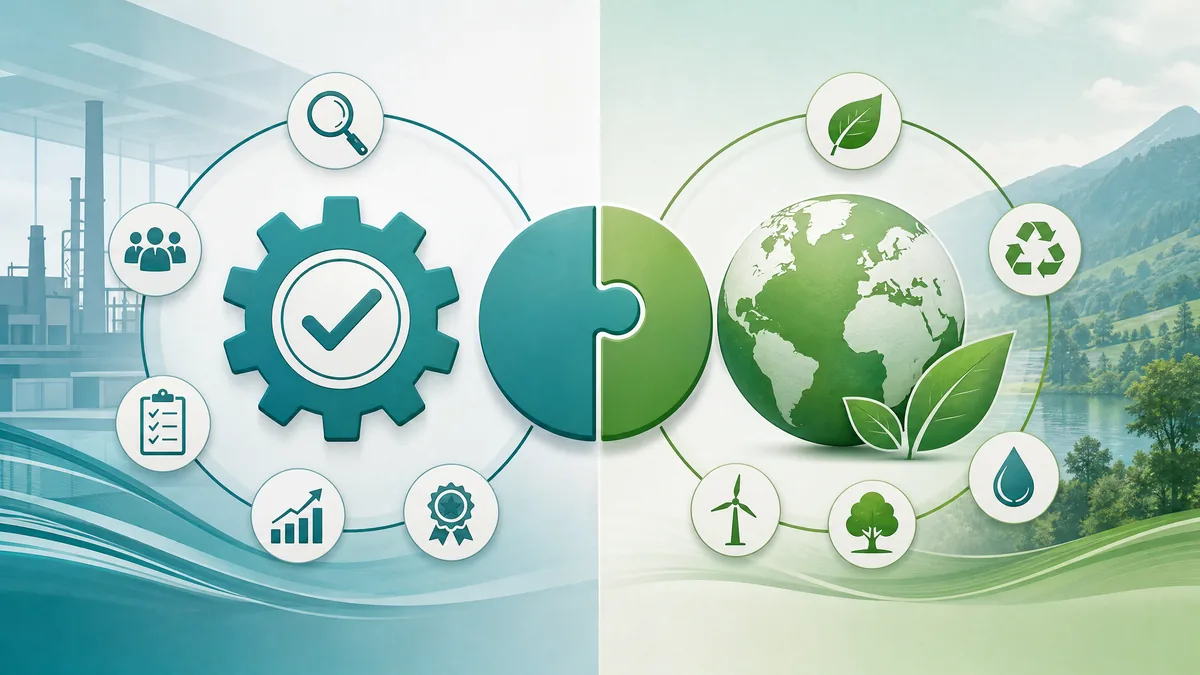
ISO 9001 vs ISO 14001 is a topic in management system certification. ISO 9001 is the international standard for Quality Management Systems (QMS). ISO 14001 is the international standard for Environmental Management Systems (EMS). Both follow the High Level Structure (HLS) in ISO's Annex SL framework. This shared structure makes integration easier than a decade ago.
Key Insight
Quick Answer:: ISO 9001 focuses on meeting customer requirements. It improves product and service quality. ISO 14001 focuses on reducing environmental impact and meeting environmental regulations. Both standards use the Plan-Do-Check-Act cycle. They can integrate into one Integrated Management System (IMS).
What Is ISO 9001?
ISO 9001 is the world's most widely adopted management system standard. Over 1 million organizations are certified in 170+ countries. The standard sets requirements for a Quality Management System. It helps organizations deliver products and services that meet customer and regulatory requirements.
ISO 9001:2026 (the upcoming revision) introduces explicit climate change considerations (Clause 4.1). It adds ethical behaviour requirements (Clause 5.1.1) and strengthens risk-based thinking. The transition deadline from ISO 9001:2015 remains September 2029.
Key focus areas of ISO 9001:
- Customer satisfaction and complaint handling.
- Process approach and risk-based thinking.
- Leadership commitment and quality policy.
- Documented information and records control.
- Internal audit and management review.
- Continual improvement and corrective action.
What Is ISO 14001?
Stay Current
ISO expects the next edition in September 2026. Get source-checked weekly briefings.
ISO 14001 is the international standard for Environmental Management Systems. It helps organizations identify, manage, monitor, and control environmental issues. ISO 14001:2015 is the current version, with over 300,000 certified organizations worldwide.
Key focus areas of ISO 14001:
- Environmental aspects and impacts identification.
- Legal and regulatory compliance.
- Environmental objectives and targets.
- Emergency preparedness and response.
- Life cycle perspective.
- Communication with stakeholders on environmental matters.
ISO 9001 vs ISO 14001: Side-by-Side Comparison
| Feature | ISO 9001 | ISO 14001 |
|---|---|---|
| Focus | Quality management | Environmental management |
| Primary goal | Customer satisfaction | Environmental protection |
| Clause 4 context | Customer/stakeholder needs | Environmental aspects |
| Clause 6 planning | Quality risks/opportunities | Environmental objectives |
| Clause 8 operations | Product/service delivery | Operational environmental controls |
| Clause 9 performance | Customer satisfaction metrics | Environmental performance indicators |
| Certification body | Same CBs (BSI, SGS, DNV, etc.) | Same CBs |
| Audit duration | Based on employee count | Based on environmental complexity |
| Current version | ISO 9001:2026 (Sept 2026) | ISO 14001:2015 |
| Transition deadline | September 2029 | No current revision planned |
Key Differences Between ISO 9001 and ISO 14001
1. Scope and Purpose
ISO 9001 is customer-focused: it ensures companies consistently meet customer requirements. It aims to enhance customer satisfaction through continual improvement. Each requirement supports delivering quality products and services.
ISO 14001 is environmentally focused: it helps companies minimize negative environmental impact. It supports compliance with environmental laws and helps meet environmental objectives. Customer satisfaction is not a primary driver of ISO 14001.
2. Clause 4 — Context of the Organization
Both standards require understanding the organization's context, but their focus differs:
- ISO 9001 Clause 4.1 requires identifying internal and external issues relevant to the QMS, including (in the 2026 revision) climate change as a relevant external issue.
- ISO 14001 Clause 4.1 requires identifying environmental conditions that affect the organization AND conditions that the organization can affect — a two-way relationship with the environment.
3. Clause 6 — Planning
- ISO 9001 Clause 6.1 focuses on risks and opportunities related to quality objectives and customer requirements.
- ISO 14001 Clause 6.1 requires a formal environmental aspects and impacts assessment — identifying which activities, products, and services have significant environmental impacts.
4. Clause 8 — Operations
This is where the standards diverge most:
- ISO 9001 Clause 8 covers the entire product/service realization process: design, purchasing, production, delivery, and post-delivery activities.
- ISO 14001 Clause 8 focuses on operational controls for significant environmental aspects, emergency preparedness, and life cycle thinking for products and services.
5. Measurement and Evaluation
- ISO 9001 Clause 9.1.2 specifically requires monitoring customer satisfaction.
- ISO 14001 Clause 9.1.1 requires monitoring environmental performance indicators (energy consumption, waste generation, emissions, etc.).
What ISO 9001 and ISO 14001 Have in Common
Both standards use the Annex SL High Level Structure. They share identical clause numbering and many identical requirements:
- Clause 4: Context of the organization (both require it).
- Clause 5: Leadership and commitment (identical structure).
- Clause 6: Planning — risk-based thinking (same approach).
- Clause 7: Support — resources, competence, awareness, communication, documented information (largely identical).
- Clause 9: Performance evaluation — internal audit, management review (same structure).
- Clause 10: Improvement — nonconformity, corrective action, continual improvement (identical).
This shared structure makes an Integrated Management System (IMS) practical and cost-effective.
Integrated Management System: Running ISO 9001 and ISO 14001 Together
An Integrated Management System (IMS) combines ISO 9001 and ISO 14001. It often also includes ISO 45001. It integrates occupational health and safety through ISO 45001 into one system. This approach is most efficient for organizations with multiple certifications.
Benefits of an IMS:
- Single set of documented procedures covering both standards.
- Combined internal audit program (one audit covers both standards).
- Single management review meeting covering quality and environmental performance.
- Reduced certification audit time and cost (combined audits are typically 20–30% shorter).
- Unified corrective action process.
- Consistent approach to risk management across both disciplines.
IMS implementation approach:
- Map the common requirements (Clauses 4–7, 9–10) and create unified procedures.
- Develop standard-specific procedures only where required (Clause 8 for each standard).
- Create a combined internal audit checklist covering both standards.
- Train internal auditors on both standards.
- Request a combined certification audit from your certification body.
Key Insight
Cost savings:: Organizations running a combined ISO 9001 + ISO 14001 IMS typically save 25–35% on certification audit costs. This compares to running two separate audits. Most major certification bodies (BSI, DNV, SGS, Bureau Veritas) offer combined audit pricing.
Which Standard Should You Get First?
If your company is new to management system certification, start with ISO 9001. ISO 9001 is more widely recognized by customers and procurement teams. That quality base makes ISO 14001 implementation much easier.
If your industry has strong environmental regulations or customers require environmental credentials, act accordingly. (common in construction, manufacturing, and public sector) ISO 14001 may be equally urgent.
For most companies, the ideal path is:
- Implement ISO 9001 first (6–12 months).
- Add ISO 14001 12–18 months later, leveraging the existing QMS infrastructure.
- Combine into a formal IMS at the next certification cycle.
ISO 9001:2026 and ISO 14001 Integration
The 2026 revision of ISO 9001 adds a climate change requirement. It appears in Clause 4.1 of the standard. It bridges quality and environmental management. Organizations must now decide if climate change is a relevant QMS external issue. This aligns with ISO 14001's environmental aspects assessment.
From September 2026, ISO 9001-certified organizations must consider environmental factors. This applies even if they do not hold ISO 14001 certification. For organizations already certified to ISO 14001, current processes largely meet this requirement.
Key Insight
Key insight:: ISO 9001:2026's new climate change clause (4.1) is the first time ISO 9001 explicitly references environmental considerations. This deliberately aligns the standard with ISO 14001. It signals future revision direction for the standard.
Certification Bodies for ISO 9001 and ISO 14001
All major certification bodies offer ISO 9001 and ISO 14001 certification. Most also provide combined audit packages:
- BSI Group — offers combined QMS/EMS audits, strong in UK and international markets.
- Bureau Veritas — strong combined audit offering, particularly in manufacturing and construction.
- SGS — global leader, strong combined audit program.
- DNV — particularly strong in energy, maritime, and oil & gas sectors.
- NQA — competitive pricing for SMEs, combined audit packages available.
See our ISO 9001 Certification Bodies ComparisonISO 9001 Certification Bodies Comparison/article/iso-9001-certification-bodies-guide for detailed pricing and accreditation comparison.
Frequently Asked Questions
Can I get ISO 9001 and ISO 14001 certified at the same time?
Yes, most certification bodies offer simultaneous initial certification audits for both standards. This is usually more cost-effective than separate audits. Stage 1 and Stage 2 can cover both standards in one visit.
Is ISO 14001 harder to implement than ISO 9001?
The two standards are comparable in overall complexity and effort. ISO 14001 requires an environmental aspects and impacts assessment, with no ISO 9001 equivalent. This assessment can challenge organizations new to environmental management. Organizations already certified to ISO 9001 typically find ISO 14001 implementation straightforward. Their management system infrastructure is in place and eases the process.
Do ISO 9001 and ISO 14001 use the same auditors?
Yes, most certification body auditors are qualified for both standards. Combined audits use auditors with dual competence in quality and environmental management.
What is the difference between ISO 9001:2026 and ISO 14001:2015?
ISO 9001:2026 is the upcoming revision of the quality management standard. It was published September 16, 2026. ISO 14001:2015 is the current version of the environmental management standard. No revision is currently planned. The two standards share the same High Level Structure. They address different management disciplines.
How long does it take to get both ISO 9001 and ISO 14001 certified?
For a company starting from scratch, expect 12–18 months for ISO 9001. Expect another 6–12 months to add ISO 14001. Companies implementing both simultaneously typically complete the process in 18–24 months.
Key Resources
- ISO 9001:2026 Transition GuideISO 9001:2026 Transition Guide/article/how-to-transition-iso-9001-2015-to-2026 — complete transition guide for ISO 9001:2026.
- ISO 9001 and ISO 14001 Integration GuideISO 9001 and ISO 14001 Integration Guide/article/iso-9001-2026-iso-14001-integration-guide — detailed integration guidance.
- ISO 9001 Certification Bodies ComparisonISO 9001 Certification Bodies Comparison/article/iso-9001-certification-bodies-guide — compare BSI, DNV, SGS, Bureau Veritas, and others.
- ISO 9001 Certification Cost GuideISO 9001 Certification Cost Guide/article/iso-9001-2026-certification-cost-guide — understand the cost of certification.
- Free Gap Analysis TemplateFree Gap Analysis Template/resources/gap-analysis-template — assess your readiness for ISO 9001:2026.