
At a glance
Use the ISO 9001 process approach to map process interactions, handoffs, owners, evidence, and improvement without treating one diagram format as mandatory.
- Focus: ISO 9001 process approach · ISO 9001 process interaction
- Read time: 9 minutes
- Updated: September 12, 2026
The Short Answer: Make Handoffs Visible, Then Improve the System
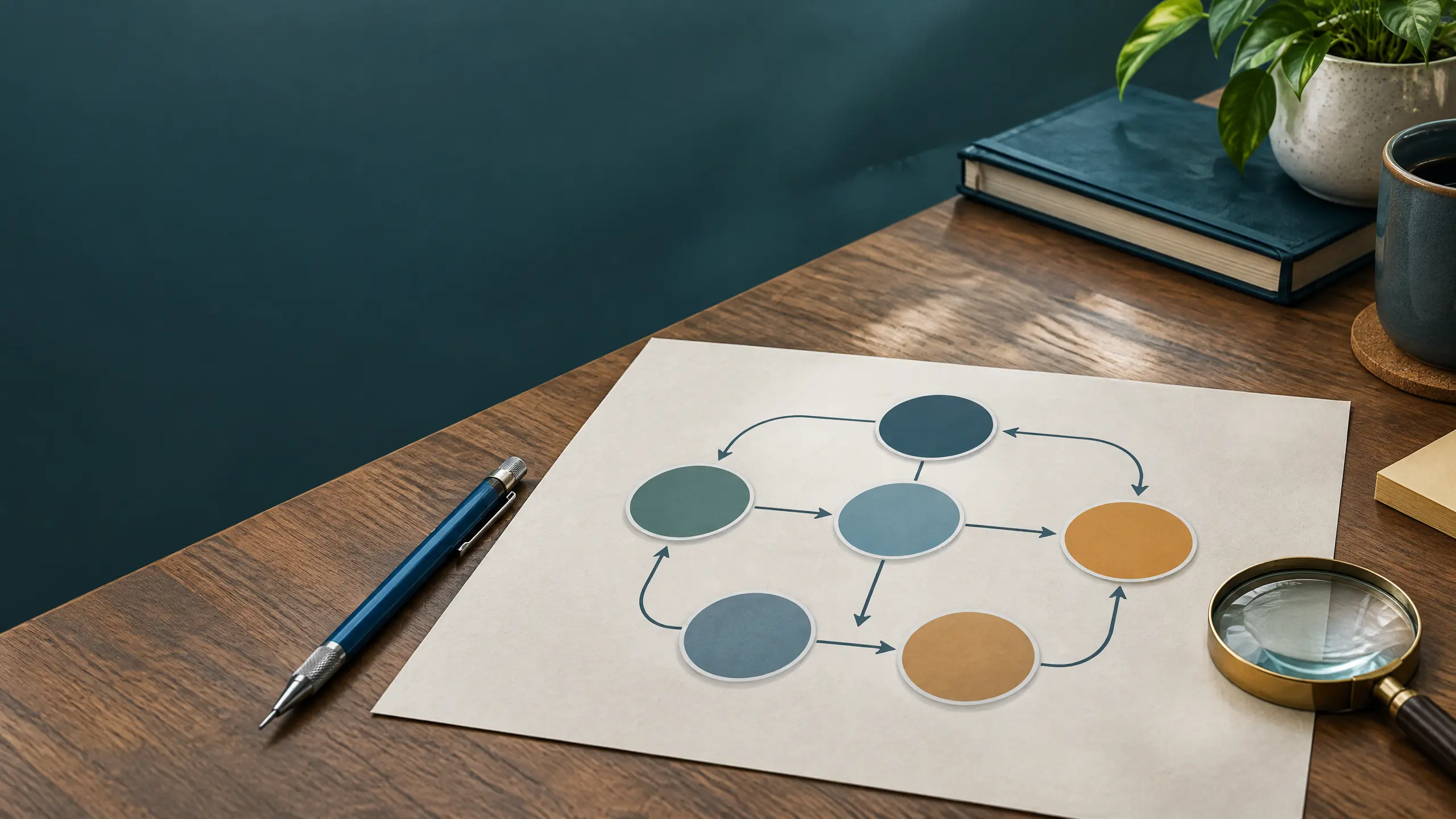
The ISO 9001 process approach is a way to manage a quality management system as connected work rather than as isolated departments or procedures. A useful ISO 9001 process map shows where work begins, what is handed from one process to another, who uses the result, and what evidence tells the team whether the process is working.
ISO describes the process approach as an essential QMS component and explains that organizations use ISO 9001:2015 by identifying key processes, defining responsibilities, controlling variation, using performance data, and improving based on evidence. It does not turn one diagram, one process count, or one software tool into a universal requirement. 11https://www.iso.org/home/insights-news/resources/iso-9001-explained.html
Reader snapshot: Start with the handoff that causes the most delay, rework, confusion, or customer frustration. Map that interaction first. A process map becomes useful when it helps people make a better decision—not when it looks elaborate.
Why Process Interactions Matter More Than a Department List
A department chart answers who reports to whom. A process-interaction view answers how customer needs, decisions, work, information, and evidence move through the organization. Those are different questions.
For example, a quotation may move from a customer-contact role to technical review, planning, delivery, release, and feedback. A quality issue can move in the opposite direction: from a complaint or a failed check to containment, investigation, corrective action, and management review. If the handoffs are unclear, a well-written procedure may still leave people guessing.
| If the map shows only… | Add this question | Why it improves the map |
|---|---|---|
| Department names | What does this process receive and provide? | Reveals the customer or internal handoff. |
| A sequence of boxes | What can go wrong at this interface? | Connects the map to risk-based thinking. |
| Process owners | What evidence tells the owner the process worked? | Connects responsibility to performance. |
| Document names | Which decision changes when this information is late or wrong? | Stops documentation becoming an end in itself. |
A Seven-Field Process Interaction Canvas
Stay Current
ISO expects the next edition in September 2026. Get source-checked weekly briefings.
Use this lightweight canvas for each important process. It is an editorial working tool, not a prescribed ISO 9001 process interaction format.
- Purpose: What useful result should this process achieve?
- Trigger: What starts the work—a request, plan, decision, event, or measured result?
- Inputs: What information, material, competence, resource, or approval is needed?
- Activities: What is the smallest useful description of the work?
- Outputs: What result is passed on, retained, or delivered?
- Owner and interfaces: Who is accountable, and which next process must be able to use the output?
- Evidence and learning: What measure, check, feedback, or review shows whether the intended result was achieved?
The canvas is deliberately shorter than a full procedure. It gives a cross-functional team a common conversation before it decides whether a flowchart, a table, a turtle diagram, a procedure, or a system screen is the most useful documentation.
Build the Map From a Customer Promise Backward
Many teams begin by listing internal functions. A more practical start is a real promise to a customer or an internal user. Trace backward from the promised output and ask what each preceding process must provide.
| Mapping step | Practical question | Example evidence |
|---|---|---|
| Define the promised result | What must be true when the customer receives the product or service? | Agreed requirement, acceptance information, delivery record, service confirmation. |
| Identify the final check or decision | Who can release, confirm, or escalate the result? | Release record, review note, approval, completed service record. |
| Trace the upstream handoffs | What must be correct before that final decision is possible? | Current specification, plan, competent resource, verified input. |
| Name the process interface | Which team or role must understand the same information? | Handoff rule, meeting output, system field, communication record. |
| Choose one learning signal | How will the organization notice variation or recurring friction? | On-time delivery trend, error rate, rework data, customer feedback, audit finding. |
This approach keeps the map tied to observable work. It also helps a team avoid drawing every possible activity before it has decided which interactions matter most.
Process Maps, Turtle Diagrams, and Procedures Serve Different Jobs
An ISO 9001 turtle diagram can be a useful way to discuss inputs, outputs, resources, methods, measures, and responsibilities. A swimlane flowchart can clarify handoffs. A procedure can explain a controlled method. A dashboard can reveal performance. None of those tools should be selected merely because another organization used it.
| Tool | Best use | Avoid assuming |
|---|---|---|
| Interaction map | Explaining the sequence and connection between major QMS processes. | That it needs every task, exception, and document number. |
| Turtle diagram | Discussing one process’s resources, measures, inputs, outputs, and controls. | That it is an ISO-required diagram. |
| Flowchart or swimlane | Making a complex handoff or decision path understandable. | That a flowchart alone proves the process is effective. |
| Procedure or work instruction | Giving people a controlled way to carry out recurring work. | That every process needs a long procedure. |
| Metric or review record | Testing whether intended results are being achieved. | That a measure is useful without an action when it worsens. |
A 30-Minute Interface Review
Use a short cross-functional review to test whether the map represents real work. Select one recent order, service request, project, complaint, change, or nonconformity. Follow it across the process boundaries rather than debating a hypothetical workflow.
- Identify the first meaningful trigger and the promised output.
- Mark each handoff where another role needs information, material, approval, or a decision.
- Ask whether the receiving role could use the output without calling the sender for clarification.
- Identify one indicator or feedback source for the interface that creates the most friction.
- Decide one improvement action, owner, and review point.
This review can connect naturally to the requirements-review guiderequirements-review guide/article/iso-9001-requirements-review-clause-8-2-3-guide, internal-communication guideinternal-communication guide/article/iso-9001-internal-communication-clause-7-4-guide, documented-information guidedocumented-information guide/article/iso-9001-documented-information-clause-7-5-guide, and internal-audit questions guideinternal-audit questions guide/article/iso-9001-internal-audit-questions-guide. Each page addresses a different part of making the QMS understandable and usable.
Key Insight
Original analytical takeaway:: A mature map is not the one with the most boxes. It is the one that lets a new process owner explain, with evidence, what they receive, what they must produce, who relies on it, and how the team learns when the interface fails.
Keep the Future Revision Separate From Today’s Improvement Work
ISO 9001:2015 remains the published requirements baseline. ISO says a revised ISO 9001 edition is expected in September 2026 and advises certified organizations to review and update their QMS when confirmed information is available. 22https://www.iso.org/standard/62085.html Strengthening a process interaction view now can be useful under the current system. It does not prove a specific future clause, map format, certification timetable, audit model, or transition deadline.
Frequently Asked Questions
What is the ISO 9001 process approach?
It is a way of managing a QMS as connected processes that work together to achieve intended results. ISO’s overview identifies the process approach among the essential ISO 9001 components. Use the controlled ISO 9001:2015 edition for exact requirement decisions.
Does ISO 9001 require a process map?
Do not assume one universal diagram, software platform, or visual format is required. Select a form of documented information and communication that helps the organization understand and control its relevant processes and interactions.
Is a turtle diagram required by ISO 9001?
No universal diagram type should be treated as mandatory. A turtle diagram can be useful for discussing one process, but it is an optional working format rather than a substitute for understanding the controlled standard.
Who should own a QMS process map?
The organization should make responsibilities clear in a way suited to its structure. In practice, the person accountable for a process needs to work with the people who provide inputs, use outputs, and review performance—not simply maintain a diagram alone.
How often should process interactions be reviewed?
Use a rhythm that suits the process and its risks. Review an interaction when performance, customer feedback, an audit, a change, or a recurring handoff issue shows that the current understanding is no longer enough.
Official Sources and Related Resources
- ISO 9001 explained — process approach and practical applicationISO 9001 explained — process approach and practical applicationhttps://www.iso.org/home/insights-news/resources/iso-9001-explained.html.
- ISO 9001:2015 catalogue and revision statusISO 9001:2015 catalogue and revision statushttps://www.iso.org/standard/62085.html.
- ISO process-approach background resourceISO process-approach background resourcehttps://www.iso.org/iso/iso9001_2015_process_approach.Pdf.
- ISO/TC 176 quality-management committeeISO/TC 176 quality-management committeehttps://www.iso.org/committee/53882.html.
- ISO 9001 QMS scope guideISO 9001 QMS scope guide/article/iso-9001-qms-scope-clause-4-3-guide.
- ISO 9001 documented-information guideISO 9001 documented-information guide/article/iso-9001-documented-information-clause-7-5-guide.
- ISO 9001 internal-audit questions guideISO 9001 internal-audit questions guide/article/iso-9001-internal-audit-questions-guide.
- ISO 9001 planning-of-changes guideISO 9001 planning-of-changes guide/article/iso-9001-planning-of-changes-guide.
- Free ISO 9001 Gap Analysis TemplateFree ISO 9001 Gap Analysis Template/resources/gap-analysis-template.