

At a glance
ISO 9001:2026 transition guide: strengthen current QMS evidence, monitor ISO status, and prepare a final-text decision record.
Direct answer
A defensible transition plan starts with the operating QMS under ISO 9001:2015, then records questions and evidence to compare against the published revision and applicable transition guidance when those are available.
- Stabilize current process evidence first.
- Keep a dated register of revision questions and source updates.
- Confirm final timing and audit arrangements with the certification body.
Primary source: ISO 9001 revision status
- Focus: ISO 9001 transition · how to transition
- Read time: 16 minutes
- Updated: August 30, 2026
What You Can Decide Before the New Edition Is Published
This ISO 9001:2026 transition guide is a planning framework for organizations currently certified to ISO 9001:2015. It is not a substitute for the published edition or for your certification body’s transition arrangements.
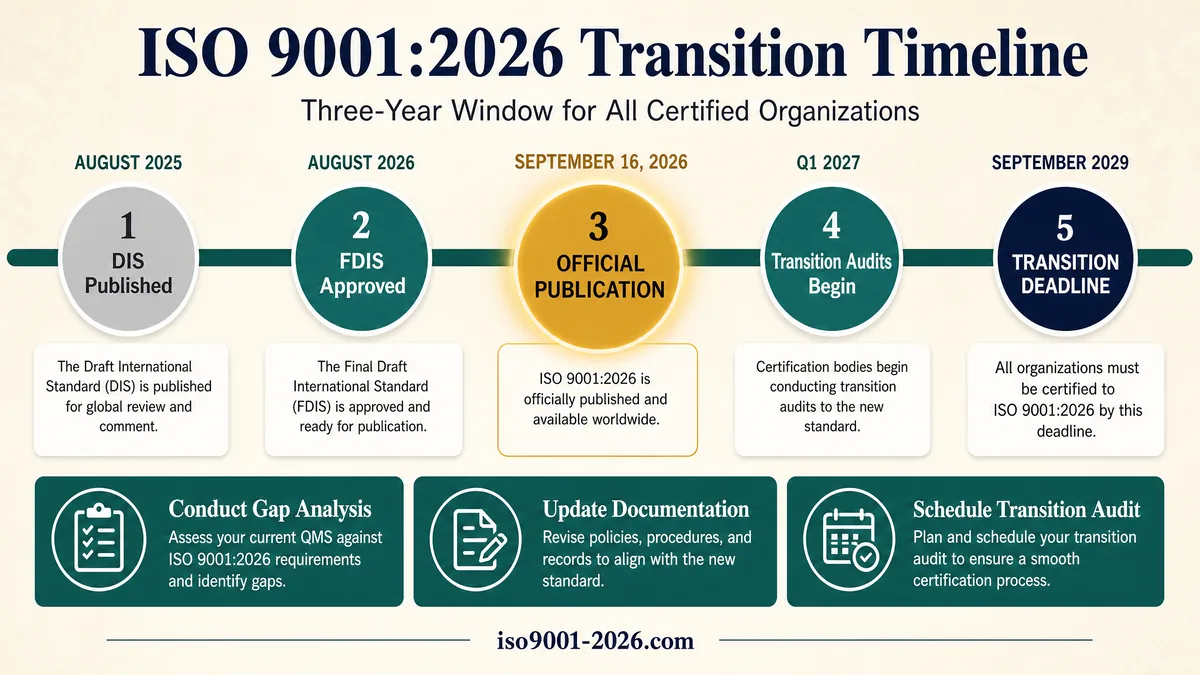
As of August 2026, ISO identifies ISO/FDIS 9001:2026 as under development, with publication planned for September 2026. A final transition deadline, audit approach, and clause wording should be treated as unconfirmed until ISO, the IAF, and your certification body publish their applicable information. The sensible decision now is not to certify a guessed implementation plan; it is to preserve evidence, identify likely change owners, and decide what can wait for the final text.
A Two-Track Transition Plan
| Decision | Useful work now | Work that should wait for the published edition |
|---|---|---|
| Governance | Name an executive sponsor, QMS owner, and certification-body contact. | Approve a clause-by-clause compliance conclusion. |
| Evidence | Keep current management-review outputs, risk records, internal-audit results, customer feedback, and corrective-action evidence in a traceable location. | Rebuild procedures around draft or commentary-only wording. |
| Gap analysis | Record where an existing process is well evidenced, weakly evidenced, or unknown. | Mark a requirement as conforming or nonconforming against an unpublished standard. |
| Audit timing | Ask your certification body how it expects to communicate final arrangements. | Book a “transition audit” against an assumed deadline or audit model. |
This distinction is practical. An organization can improve the quality of its evidence now without pretending it knows the final requirement. For example, a management-review record that identifies a decision, its evidence, and its owner will remain useful whether or not final wording changes; a rewritten procedure based on an unverified clause summary may have to be redone.
What This Guide Can and Cannot Tell You
Stay Current
ISO expects the next edition in September 2026. Get source-checked weekly briefings.
The official source establishes the current publication status. The planning judgment in this guide is editorial: preserve decision evidence, identify owners, and avoid irreversible document rewrites before the final edition is available. It cannot confirm final clause wording, transition dates, certification-body audit arrangements, or the amount of change required in a particular organization.
Step 1: Confirm the Current Controlled Baseline
Use ISO 9001:2015 for current QMS requirements and retain the controlled copy or applicable subscription record. ISO lists ISO/FDIS 9001 as under development with publication planned for September 2026; do not purchase, audit against, or declare conformity to an unpublished edition.ISO 9001:2015ISO 9001:2015https://www.iso.org/standard/62085.html ISO/FDIS statusISO/FDIS statushttps://www.iso.org/standard/88464.html
Step 2: Build an Evidence Baseline
For each process that affects intended QMS results, note the current control, available evidence, accountable owner, and known weakness. This is useful improvement work now and does not require an assumption about final future-edition wording.
Step 3: Create a Final-Text Question Register
Translate every reported revision theme into a neutral question. For example: “Does the published edition alter the applicable requirement or guidance for this current process?” Record the source, date checked, process owner, and evidence to compare after publication.
Step 4: Review Current Management and Audit Evidence
Use current ISO 9001:2015 evidence such as management-review outputs, internal-audit results, customer feedback, corrective actions, competence records, and supplier controls to decide where the QMS needs attention today. Do not label these activities as compliance with an unpublished edition.
Step 5: Set Decision Gates for Publication and Certification Guidance
After the final edition and any applicable certification-body communication are available, compare them with the evidence baseline. Then decide whether the QMS needs a controlled impact assessment, an internal audit update, training, or an external audit arrangement. Retain the dated source and rationale for each decision.
Build a Transition Decision Record, Not a Draft Compliance Claim
A transition plan becomes useful when each action can be traced to a decision source. Keep one short record for every material question rather than spreading assumptions across procedures, slides, and audit plans.
| Record field | Example question | Evidence to retain |
|---|---|---|
| Current control | What ISO 9001:2015 process or record applies today? | Controlled procedure, current audit criterion, or management-review output. |
| Revision question | What must be confirmed from the published edition? | Exact question, relevant process owner, and official source link. |
| External arrangement | Does our certification body have an applicable confirmed message? | Dated written communication, contact, scope, and audit-cycle relevance. |
| Decision | Monitor, prepare evidence, or start a controlled impact assessment? | Decision owner, rationale, review trigger, and next date. |
The quality of this record matters more than the volume of early document changes. It lets a team demonstrate deliberate preparation while preserving the distinction between current conformity and a future-edition assessment.
Recommended Decision Gates
| Gate | Decision to make | Evidence to retain |
|---|---|---|
| Before publication | Are owners, baseline records, and certification-body contacts in place? | Named owners; evidence inventory; current-certificate details. |
| After publication | Which final changes apply to this QMS and which do not? | Controlled copy of the edition; dated gap record; rationale for each decision. |
| After certification-body guidance | What audit route and timing are available? | Written guidance or proposal; internal decision record; audit plan. |
| Before the external audit | Is the implemented change effective in day-to-day operation? | Internal-audit findings, management-review decisions, training or communication evidence, and effectiveness follow-up. |
Where to Get the Standard and Tools
Purchasing ISO 9001:2026: When the edition is published, obtain it through ISO.orgISO.orghttps://www.iso.org/standard/62085.html or the appropriate national standards body. Check the seller’s current price and edition status rather than relying on a generic estimate.
Gap analysis tools: Use our ISO 9001 Gap Analysis TemplateISO 9001 Gap Analysis Template/resources/gap-analysis-template to inventory current evidence, accountable owners, and questions for the final edition. Do not score conformity against unpublished requirements.
Certification-body and IAF information: Review transition information issued by your certification body and the International Accreditation ForumInternational Accreditation Forumhttps://www.iaf.nu once applicable arrangements are published. Keep a dated copy of the guidance that informed your timing decision.
Comparison guide: For a clause-by-clause breakdown, see our ISO 9001:2026 vs ISO 9001:2015 complete comparisonISO 9001:2026 vs ISO 9001:2015 complete comparison/article/iso-9001-2026-vs-2015-complete-comparison.
Related Transition Reading
- ISO 9001 Gap Analysis GuideISO 9001 Gap Analysis Guide/article/iso-9001-gap-analysis-guide — how to assess your current QMS against the revised requirements.
- ISO 9001 Certification ProcessISO 9001 Certification Process/article/iso-9001-certification-process-guide — what happens from readiness review through certification.
- ISO 9001 Compliance ChecklistISO 9001 Compliance Checklist/article/iso-9001-compliance-checklist-2026 — clause-by-clause evidence and implementation checks.
Frequently Asked Questions: ISO 9001:2026 Transition
What is the best place to start preparing for ISO 9001:2026?
Start with an evidence baseline and the questions your organization must resolve after the published edition is available. This guide can help organize that work; the official edition and your certification body’s applicable guidance must govern the final transition decision.
How to implement ISO 9001:2026 — where do I start?
Start by strengthening evidence against the current ISO 9001:2015 baseline, then maintain a dated question register for the published edition. After final text and applicable certification-body guidance are available, conduct a controlled impact assessment rather than assuming requirements, clause numbers, or audit timing in advance.
Can I transition before the standard is officially published?
You can prepare records, identify owners, and review current evidence. Do not treat that work as a formal ISO 9001:2026 transition or assume a certification arrangement before the published edition and your certification body’s guidance are available.
What happens if the organization delays its transition decision?
The consequences depend on the eventual transition arrangements and the certification body’s programme. Keep a dated record of the guidance you receive and reassess audit timing once the official schedule is published; this guide does not assume a deadline that has not been confirmed.
How much does a transition audit cost?
No future-edition transition audit arrangement or cost can be assumed before applicable guidance is published. When arrangements are available, request a written quote that states scope, audit time, travel, and the reason each charge applies.
Do I need to hire a consultant for the transition?
The appropriate support model depends on the organization’s current evidence, internal competence, scope, and the final published requirements. Preserve a current evidence baseline first; then decide whether internal expertise or independent support is warranted.
Will my certification body notify me about the transition?
Do not assume timing or notification arrangements. Keep a current contact, request applicable information when it is available, and retain dated written communication that supports the organization’s decision.